



CLEVER FREELANCER AI DISCOVERY PLAYBOOK
Your Customers Are Asking AI Who to Hire. Will They Find You?
Here’s the uncomfortable question every local business owner should ask: when a customer asks Google, ChatGPT, Gemini, or a voice assistant who can solve a problem nearby, does your business become part of the answer—or disappear behind a competitor?
Customers are no longer searching only for broad phrases such as “window treatments” or “coffee shop.” They are asking layered, conversational questions: “Who installs motorized shades near me?” “What blinds work for a 20-foot sliding glass door in Naples?” “Which local company can measure and install this week?”
That shift is why hyperlocal Answer Engine Optimization—hyperlocal AEO—matters. It is not a replacement for local SEO. It is the practical next layer: make your business easy to find, easy to understand, and easy for both people and AI-powered search experiences to recommend.
At Clever Freelancer, we like strategies that produce something more useful than a new acronym. So this guide uses live search data from EV Blinds, a Southwest Florida window-treatment manufacturer, to show where the real opportunities are and what a small business can do next.
What Is Hyperlocal AEO?
Hyperlocal AEO is the practice of making your business the clearest, most credible answer for a specific service, problem, and nearby location.
Traditional local SEO helps a business rank in organic search and map results. Local AEO makes the same business easier to cite or recommend in AI-generated answers. Hyperlocal AEO goes one level deeper by connecting a service to a neighborhood, landmark, property type, local condition, or urgent need.
Local SEO
Example: “window treatments Fort Myers”
Local AEO
Example: “who installs custom shades in Fort Myers?”
Hyperlocal AEO
Example: “motorized blackout shades for a waterfront condo in Naples”
The goal is not to stuff neighborhood names into every paragraph. The goal is to prove that you understand the customer’s actual setting and can solve the problem there.
A Reality Check
This is important because the internet is filling up with expensive shortcuts.
Google’s current guidance says the same SEO fundamentals used for traditional Search also apply to AI Overviews and AI Mode. A page must be indexable and eligible to appear in Search, but there is no separate technical requirement, special AI schema, or magic machine-readable file required for inclusion.
Do the fundamentals exceptionally well, then make the content specific enough to deserve the answer.
What EV Blinds’ Live Search Data Reveals
We reviewed EVBlinds.com’s Google Search Console performance for April 13 through July 12, 2026. During that 90-day period, the site appeared in search results 118,086 times but earned 492 clicks, with an average position of 28.9.
That gap is not bad news. It is a map of where demand already exists.
1,648 Impressions
0 clicks
1,181 Impressions
3 clicks
597 Impressions
0 clicks
555 Impressions
0 clicks
449 Impressions
14 clicks
431 Impressions
0 clicks
The pattern is clear. EV Blinds already has strong visibility around motorized products, installation, Fort Myers, Naples, Punta Gorda, Port Charlotte, and “near me” intent. But much of that visibility is not yet turning into visits.
Cape Coral shows the opportunity from the other direction: when location and service intent line up well, clicks follow. A smart content plan should not start by inventing 50 new topics. It should improve the high-impression pages and query clusters Google is already testing.
The Seven-Part Hyperlocal AEO Framework
- 1. Start with the questions you already appear for.
Group Search Console queries by product, location, problem, property type, urgency, installation, price, and availability. - 2. Build pages around real service-and-location matches.
Create a dedicated page only when you can provide genuinely useful local information. Avoid thin pages that merely swap city names. - 3. Put the best answer near the top.
Quickly explain the service, location, ideal customer, differentiator, and next step. - 4. Add local proof, not local fluff.
Use original project photos, location-specific reviews, local conditions, realistic turnaround times, and case studies. - 5. Turn reviews into an answer library.
Encourage customers to naturally mention the service, area, problem, and outcome—without scripting or incentivizing reviews. - 6. Use structured data honestly.
LocalBusiness, Organization, Article, Breadcrumb, Product, and relevant schema should match visible page content. - 7. Connect the local trust network.
Align the website, business profiles, directories, reviews, social profiles, and genuine local relationships.
What Small Businesses Should Stop Doing
- Stop publishing hundreds of AI-written city pages. Scale does not replace experience, originality, or accuracy.
- Stop chasing a “perfect” word count. Google explicitly says it does not have a preferred word count.
- Stop assuming image geotags will create rankings. Original media, descriptive context, and strong pages matter more than hidden metadata alone.
- Stop adding schema the page does not support. Structured data should clarify the truth, not manufacture it.
- Stop measuring only rankings. Track impressions, clicks, calls, forms, appointments, and qualified leads.
A Better AI Prompt for a Hyperlocal Service Page
AI can speed up research and drafting, but it should not invent your local expertise. Use a prompt that forces the model to work from verified inputs:
You are helping [BUSINESS NAME], a [BUSINESS TYPE], improve its existing page for [SERVICE] in [CITY OR NEIGHBORHOOD]. The page is [URL].
Use only the verified facts provided below. Do not invent landmarks, reviews, certifications, prices, service areas, timelines, or customer claims.
Verified business facts: [FACTS]Real customer questions: [QUESTIONS]Search Console queries: [QUERIES]Local conditions or property types: [LOCAL DETAILS]Original proof available: [PHOTOS, REVIEWS, CASE STUDIES, CERTIFICATIONS]Primary next step: [CTA]
Draft a clear, conversational service page that answers the main question in the first paragraph. Include service details, local considerations, a short process, proof, helpful FAQs, and the next step. Flag every statement that still needs human verification. Avoid keyword stuffing, generic claims, and duplicated city-page language.
The final review still belongs to a human who knows the business and the area. AI should help organize your expertise—not impersonate it.
A Practical 30-Day Hyperlocal AEO Plan
Week 1: Find
Week 2: Improve
Week 3: Trust
Week 4: Measure
Hyperlocal AEO Questions Small Businesses Ask
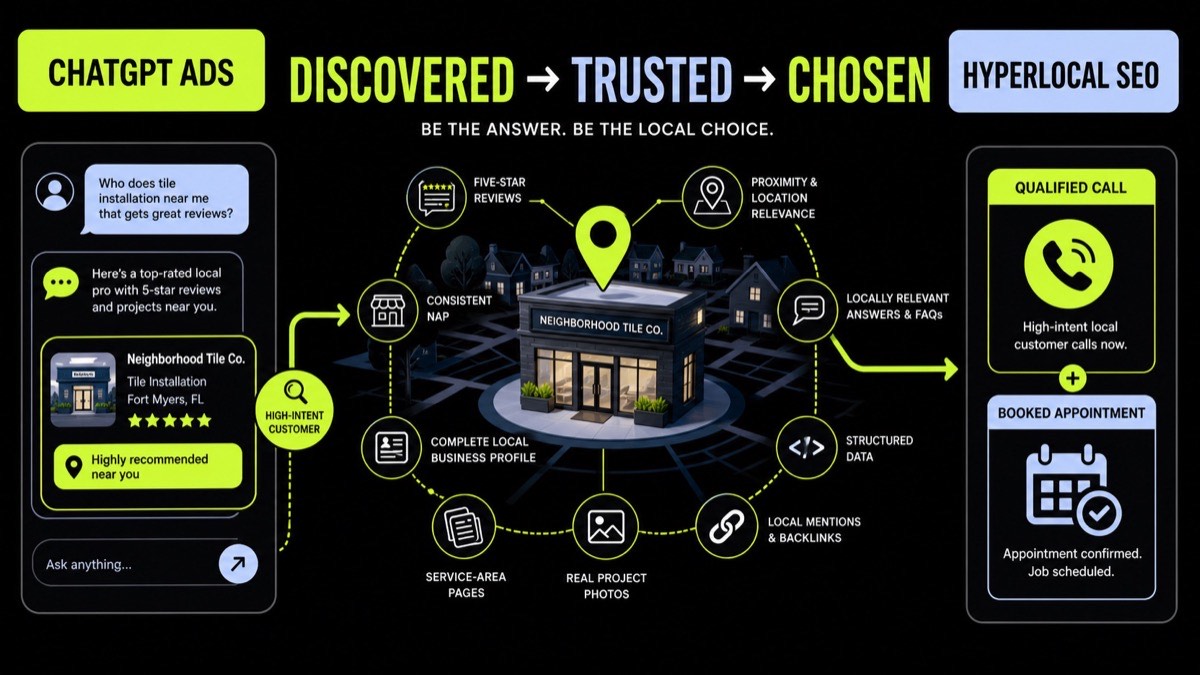
Be the Answer. Be the Local Choice.
Hyperlocal AEO is not about gaming an AI system. It is about becoming the most useful local source for a specific customer question.
The businesses most likely to win combine strong SEO foundations with what AI cannot fabricate: real experience, real customers, real local proof, and a clear answer.
Your customers are already asking AI who to hire. Will they find you?