



CLEVER FREELANCER LOCAL VISIBILITY LAB
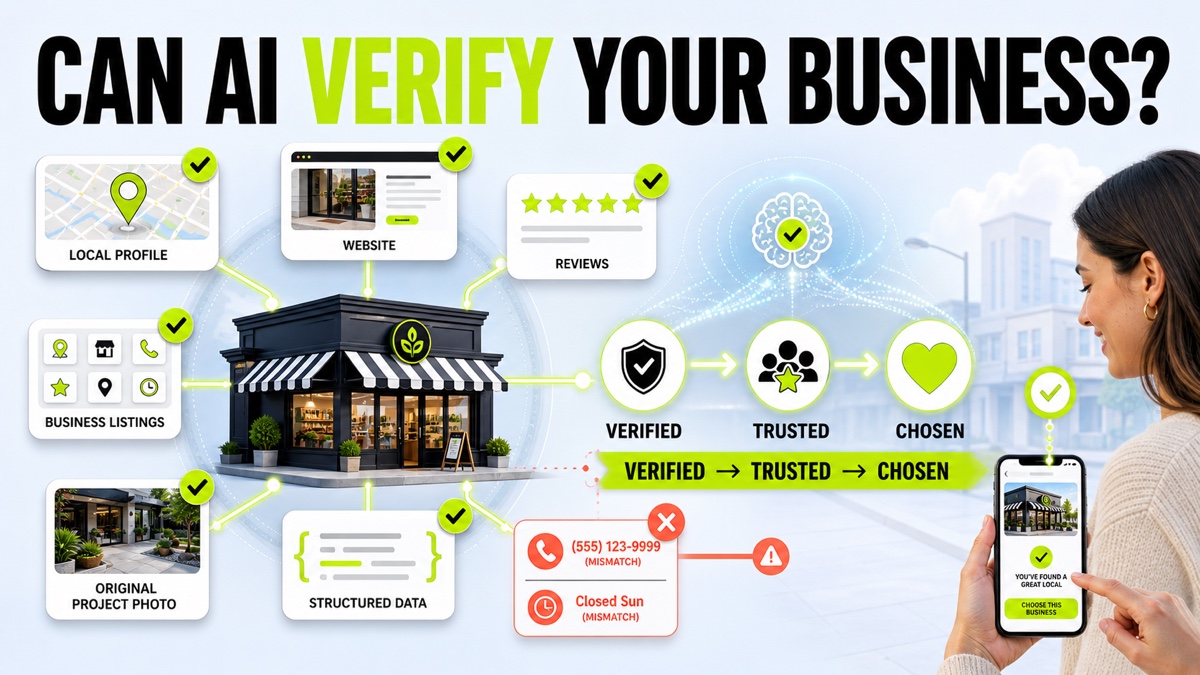
Can AI Verify Your Business? Run This 15-Minute Local Presence Audit
Two customers can stand in the same city, ask nearly the same question, and receive different local recommendations. That is no longer a theoretical edge case. Google now offers personalized recommendations in AI Mode and Ask Maps, while assistants and answer engines assemble responses from business profiles, websites, reviews, listings, and other public evidence.
For a small business owner, the practical question is not “How do I trick AI into mentioning me?” It is simpler and more useful: can a customer—or a system helping that customer—verify who you are, what you do, where you work, and why you are a credible choice?
A recent Birdeye session on Google’s AI search changes raised the same visibility problem for brands. We fact-checked the actionable parts against current Google, Microsoft, Apple, and HighLevel documentation, then turned them into a small-business audit you can actually finish before your next cup of coffee gets cold.
Local Visibility Is Becoming an Evidence Problem
Old-school local search often felt like a position problem: “Am I number one, two, or three?” Rankings still matter, but AI-assisted discovery adds a second challenge. A recommendation must be assembled from enough consistent evidence to feel useful and defensible for that particular customer.
Google says its local results are mainly based on relevance, distance, and prominence. It also advises businesses to keep information complete and accurate, verify the profile, maintain hours, respond to reviews, and add photos. For Google’s generative AI features, the company says normal SEO fundamentals still apply; there is no special AI schema or secret file that guarantees inclusion.
Translation: the businesses that are easiest to understand and verify give both customers and platforms fewer reasons to hesitate.
The Clever Truth Chain
Choose one page—usually your website contact or location page—as the canonical source of business truth. Your Google Business Profile, Apple Business Connect place card, Bing Places listing, major directories, social profiles, invoices, and email signatures should mirror it.
We call this the Truth Chain:
Business fact → profile → website page → review or proof → action.
If the website says you close at 5, Google says 6, Apple Maps has an old phone number, and Facebook points to a retired domain, every mismatch creates a tiny “customer confusion tax.” One mismatch may not destroy visibility, but enough contradictions can cost calls, directions, form submissions, and trust.
The 15-Minute Local Presence Fire Drill
Open a private browser window so your normal search history has less influence. Keep one document open for mismatches. The goal is not to fix everything in 15 minutes; it is to find the places where customers may be receiving conflicting answers.
Minutes 0–3: Find Yourself
Minutes 3–6: Verify the Facts
Minutes 6–9: Inspect Reviews
Minutes 9–12: Test the Website
Minutes 12–14: Try Real Questions
Minute 15: Choose One Fix
Clever Tip #1: Run the Three-Screen Test
Put Google Maps, Apple Maps, and Bing Maps side by side. Search your business by name, then compare what a first-time customer sees.
Do not stop at name, address, and phone. Compare the primary category, service area, hours, photos, description, website destination, booking link, and the language customers use in reviews. These screens do not need to look identical, but the underlying business facts should agree.
Why this is clever: many owners audit the profile they update most often and assume the rest of the web followed along. The Three-Screen Test exposes yesterday’s truth before a customer follows it.
Apple
Bing
Clever Tip #2: Build an Evidence Ladder, Not a Claim Pile
“Best,” “trusted,” and “full service” are claims. A local presence becomes stronger when each important claim has a rung of proof beneath it.
- Claim: “We install motorized shades.”
- Service page: Explain products, compatibility, process, timing, and who the service fits.
- Original proof: Show a real installation, team member, storefront, vehicle, product, or before-and-after result.
- Customer language: Earn honest reviews that naturally mention the service and outcome. Never script or incentivize praise.
- Local context: Add the real city, neighborhood, property type, conditions, or service boundary when it helps the customer decide.
- Working action: Give the customer a valid phone, form, booking link, directions, or next step.
One page with a complete Evidence Ladder is more persuasive than ten thin pages repeating the same unsupported adjectives.
Your Small-Business Local Presence Audit
Clever Tip #3: Service-Area Businesses Need a Boundary Test
Plumbers, mobile detailers, installers, landscapers, consultants, and other service-area businesses should not pretend to have a storefront. Your audit should test whether the business is discoverable and credible across the places it truly serves.
Choose one priority search phrase, then check it near the center of your service area, at the edge, and in one growth market. Record which competitors appear, what their profiles and landing pages prove, and whether your own website has useful content for the customer’s actual need.
HighLevel’s current Prospecting guidance supports service-area businesses without public storefronts, and its audit can treat the street address as neutral when it is not applicable. That is a better model than penalizing a legitimate mobile business for protecting a home address.
Request a Clever Local Presence Check
Clever Freelancer can run a HighLevel-powered Marketing Audit Report through our CleverPixels agency profile. Depending on the available business data, the report can surface review information, listings accuracy and gaps, website performance, Google Business Profile health, local rankings, and geo-grid opportunities.
Important: this is a diagnostic snapshot, not a guaranteed ranking forecast. We pair the report with a human review so owners understand which findings are urgent, which are optional, and which are simply not applicable.
Want the System Behind the Audit?
HighLevel combines CRM, forms, automation, reputation tools, listings, reporting, and Prospecting features in one platform. It is most useful when you have a clear follow-up process—not when you are collecting software for its own sake.
If you run an agency, manage multiple locations, or want to connect audit findings to lead capture and follow-up, you can explore HighLevel through the CleverPixels referral link below.
Affiliate disclosure: Clever Freelancer may earn a commission if you start HighLevel through this link, at no additional cost to you. We only recommend using the platform when its workflow fits your business.
Five Local-Presence Mistakes That Waste Time
- Chasing a perfect audit score. Scores help prioritize. They do not override relevance, distance, competition, customer experience, or the quality of your offer.
- Building profiles you will never maintain. Claim the important platforms first, document ownership, and assign a quarterly review date.
- Publishing city-name clones. Google warns against scaled, low-value content. Create a local page only when you can add real differences, proof, and customer usefulness.
- Treating review replies as keyword containers. Respond like a human, protect customer privacy, address the experience, and avoid forcing services or city names into every reply.
- Calling every mismatch a ranking factor. Fix contradictions because they confuse customers and weaken the information chain—not because every directory field has a proven one-to-one effect on ranking.
Turn the Audit Into a 30-Day Fix Loop
Week 1: Correct
Week 2: Prove
Week 3: Earn
Week 4: Measure
Repeat the 15-minute fire drill every quarter and after any move, rebrand, phone change, seasonal-hours change, new service, or website redesign. Local presence is not a cleanup project you finish once. It is a small operating system for keeping the public version of your business true.
What We Verified Before Publishing
This article was reviewed against current first-party documentation available on July 15, 2026:
- Google Business Profile local ranking guidance
- Google’s optimization guide for generative AI features
- Google’s Ask Maps announcement and personalization details
- Microsoft Bing Places for Business and Apple Business Connect
- HighLevel Local Marketing Audit guidance and the live CleverPixels agency/sub-account tools
We intentionally avoided promising that listing consistency forces AI citations, that audit grades guarantee rankings, or that businesses need special “AI schema.” Those claims are stronger than the available evidence.
Local Presence Audit Questions Small Businesses Ask
Make Your Business Easy to Verify—and Easy to Choose
The goal is not to be everywhere. It is to be accurate in the places that matter, useful for the questions customers ask, and credible enough that every profile, page, review, and action reinforces the same business truth.
If you want to go deeper after the audit, read our small-business guide to hyperlocal AEO.
Verified. Trusted. Chosen. That is the local visibility sequence worth building.